
Accuria Returns to Cambridge to Discuss AI in Loan Management and Software Development
Earlier this week, Accuria delivered a guest lecture at the University of Cambridge on AI in finance. This was the third time we’ve been invited to present to Cambridge students, and each visit has reflected how quickly the field is evolving. What started two years ago as a talk about applying machine learning to loan portfolios has evolved into a full session on agentic AI workflows, domain-specific AI agents and the practical engineering behind deploying AI in regulated financial services.
This year’s lecture was delivered by Burkhard Heppe, our CTO, and Theodore Gavriilidis, Senior AI Engineer at Accuria. The session focused on three key areas: how AI is transforming back-office operations in credit markets, the architecture behind building reliable AI agents for financial workflows, and a live case study on agentic loan workout.
From document processing to agentic workflows
The core of the lecture focused on how back-office automation is evolving. Two years ago, the state of the art was deterministic pipelines and linear AI workflows with fixed rules, fixed extraction templates, fixed outputs. Those pipelines worked for narrow use cases but broke whenever document formats changed or edge cases appeared.
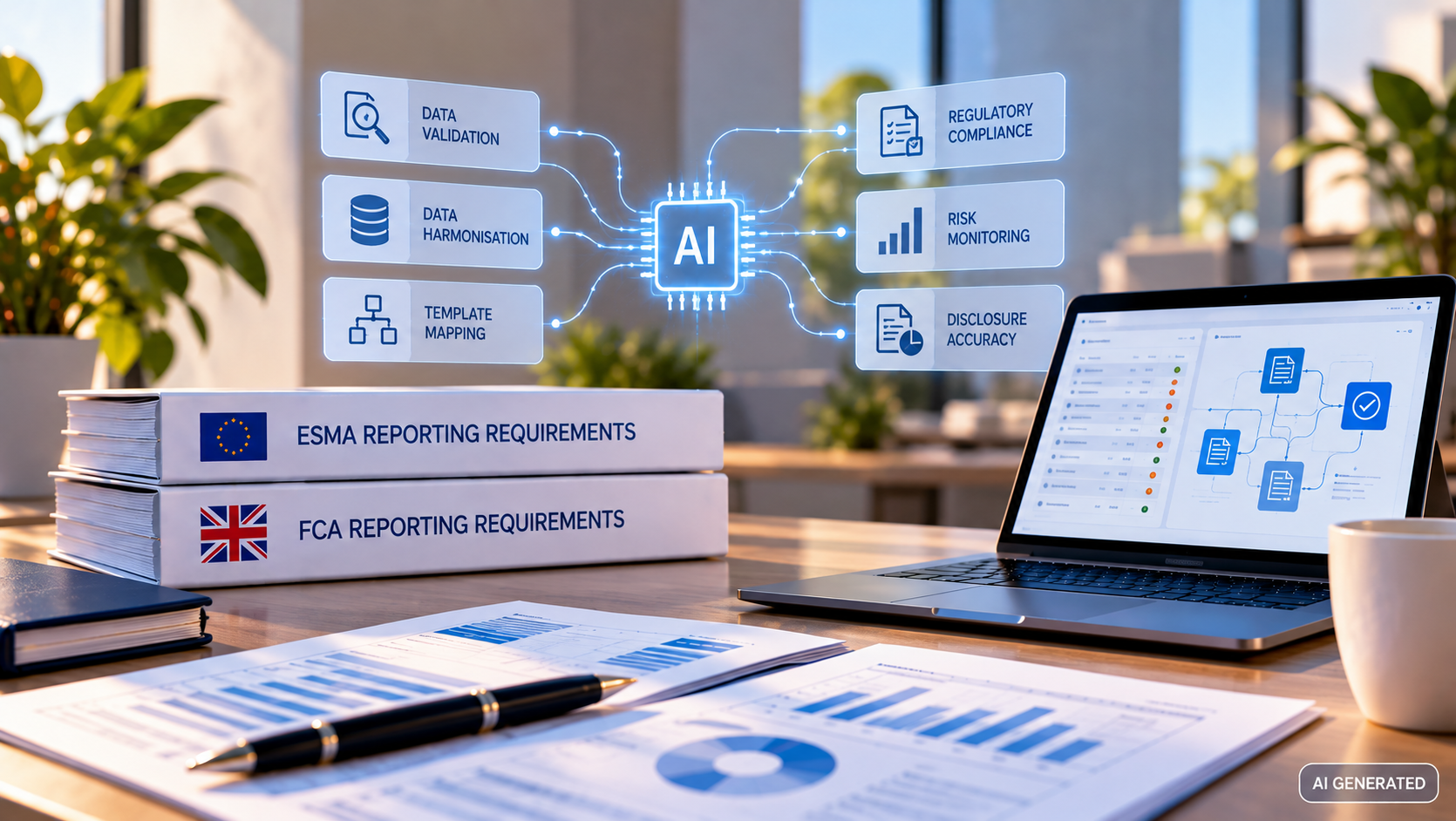
Today we’re building agentic workflows where AI orchestrators coordinate multiple specialised tasks: document classification, data extraction, validation, and output generation. The agent decides how to approach each document based on what it finds, rather than following a static script. Take an automated loan restructuring preceding a projected covenant breach as an example. Document classification runs autonomously above a confidence threshold, identifying critical files and tracking deliveries. Financial metric calculations execute deterministically with a full audit log. But the final restructuring recommendation always requires human approval ensuring all key decisions are made by the users.
What we showed
We walked through Accuria’s products in detail.AI Document Analysis handles the heavy lifting across document digitisation, classification, information extraction, loan data tape enrichment, and covenant monitoring. We demonstrated how it processes thousands of files, including scanned PDFs with handwritten notes, and produces structured outputs with full traceability: every extracted value links back to its source page and carries a confidence score.
We also presented our AI Data Agent, our conversational interface for querying credit portfolios. Users connect their loan data tape and performance data, ask questions in plain language, and get publication-ready charts, tables, and written analysis in seconds. The agent handles portfolio stratification, performance trend analysis, and data onboarding across asset classes. A standout capability is our AI Portfolio Mapping Agent that takes messy source spreadsheets (Loan Data Tapes), inspects the data, identifies primary keys and relationships across sheets, and maps everything to a target schema with guided human review.
 Figure 1: AI Data Agent (source Accuria)
Building agents that work in production
The second half of the lecture shifted to how we build these systems. We covered the engineering principles behind reliable AI agents: context engineering over prompt engineering, the observe-plan-implement-evaluate loop, structured tool design, and why context window management silently degrades performance when done poorly. We also talked about the complexities of building long-running autonomous agents. They can fail in unpredictable ways, and the difference between a demo and a production system comes down to error handling, durability, observability, security, and cost control.
Looking ahead
We’re grateful to the University of Cambridge for having us back for a third time, and to the students who asked sharp questions throughout. For more information contact us at accuria.com.
This presentation and the information contained herein does not constitute or form part of any (i) offer or invitation or inducement to sell or issue, or any solicitation of any offer to purchase or subscribe for, any securities or (ii) invitation or inducement to engage in investment activity within the meaning of Section 21 of the United Kingdom Financial Services and Markets Act 2000, as amended, nor shall any part of this presentation nor the fact of its distribution form part of or be relied on in connection with any contract or investment decision relating thereto.
Download the article here: Accuria Returns to Cambridge to Discuss the Use of AI in Loan Management and Software Development